My Dad passed away at the start of 2022, and my Mom decided to sell the house shortly after. I was on the East Coast for work, so I stopped by before heading home and spent about six hours going through my childhood bedroom closet, making quick decisions about what could fit into the three oddly shaped boxes I was shipping back to LA.
They were oddly shaped because I had already made the correct adult decision to prioritize two guitars.
When I got to the comic books I had not looked at in more than 20 years, I started shoving stacks into whatever empty space was left. In retrospect, this was not archival best practice. I had no real idea what issues I had, what condition they were in, or whether I was preserving anything coherent. I just knew I wanted them.
A week or two later, I had a stack of old comics sitting in my house and no real system for them.
I wanted to keep the books, but I still needed a practical way to catalog them.
Rediscovering the collection
I did what any reasonable person would do and opened a spreadsheet. Titles in one column. Issue numbers in another. Maybe a note about condition if I was feeling ambitious. About 30 minutes in, I was already tired of entering data.
Then I found CovrPrice, which was immediately better than my spreadsheet. I could see cover art, group issues by title, sort by release date, track estimated values, and generally treat the collection like an actual collection instead of a list of things I half-remembered owning.
CovrPrice did one important thing right: it made the collection visible again. That mattered. It also got me back into collecting. Three years later, I still visit MidTownComics.com religiously, buying new releases and hunting down issues I missed as a kid.
Keeping the inventory current was harder. A collection is only useful if the inventory stays current. The second logging new books feels like a chore, the inventory becomes incomplete.
The maintenance problem
A couple months ago, I got an email from CovrPrice saying my yearly subscription price was going up by 50%. I understand that running a web app is not cheap, and I am not offended by software costing money. Good tools should cost money. People should be paid.
But once I was using CovrPrice every week, the friction became impossible to ignore. It was slow. It was cumbersome. Routine updates required too many page loads.
The real problem was not storing comics. It was maintaining the state of the collection without making myself hate the process.
Adding new purchases took too long. Search, click, wait, add, wait, confirm, wait, repeat. Forms loaded slowly. Pages loaded slowly. The delay discouraged me from making small updates.
Instead of logging five new books when they arrived, I would put them aside. Then there would be 12. Then 20. Then I would have a growing stack of unlogged books next to my desk.
A subscription is less appealing when using the product discourages the task you bought it for. At that point, you either accept the mismatch, stop maintaining the archive, or build something that fits.
Building the tool around the habit
Around the same time, a few things converged. I had been getting slowly addicted to what I call “vibe-coding” with AI assistants like bolt.new. We went on vacation for two weeks in the South of France, where I naturally spent too much time thinking about side projects. And while we were there, bolt.new had some kind of free tokens weekend that made experimentation feel cheap enough to try.
I have a love/hate relationship with tools like that. They are very good at starting projects and getting you 80% of the way there. Then, eventually, they can consume tokens repeating failed fixes until you intervene and debug the code.
AI made it easier to test the shape of the app quickly, but I needed a real workflow against which to judge the result. The reason the AI-assisted build worked at all is that the problem was not abstract. I had the books, the pain point, the fields, the habits, and the failure mode sitting in front of me.
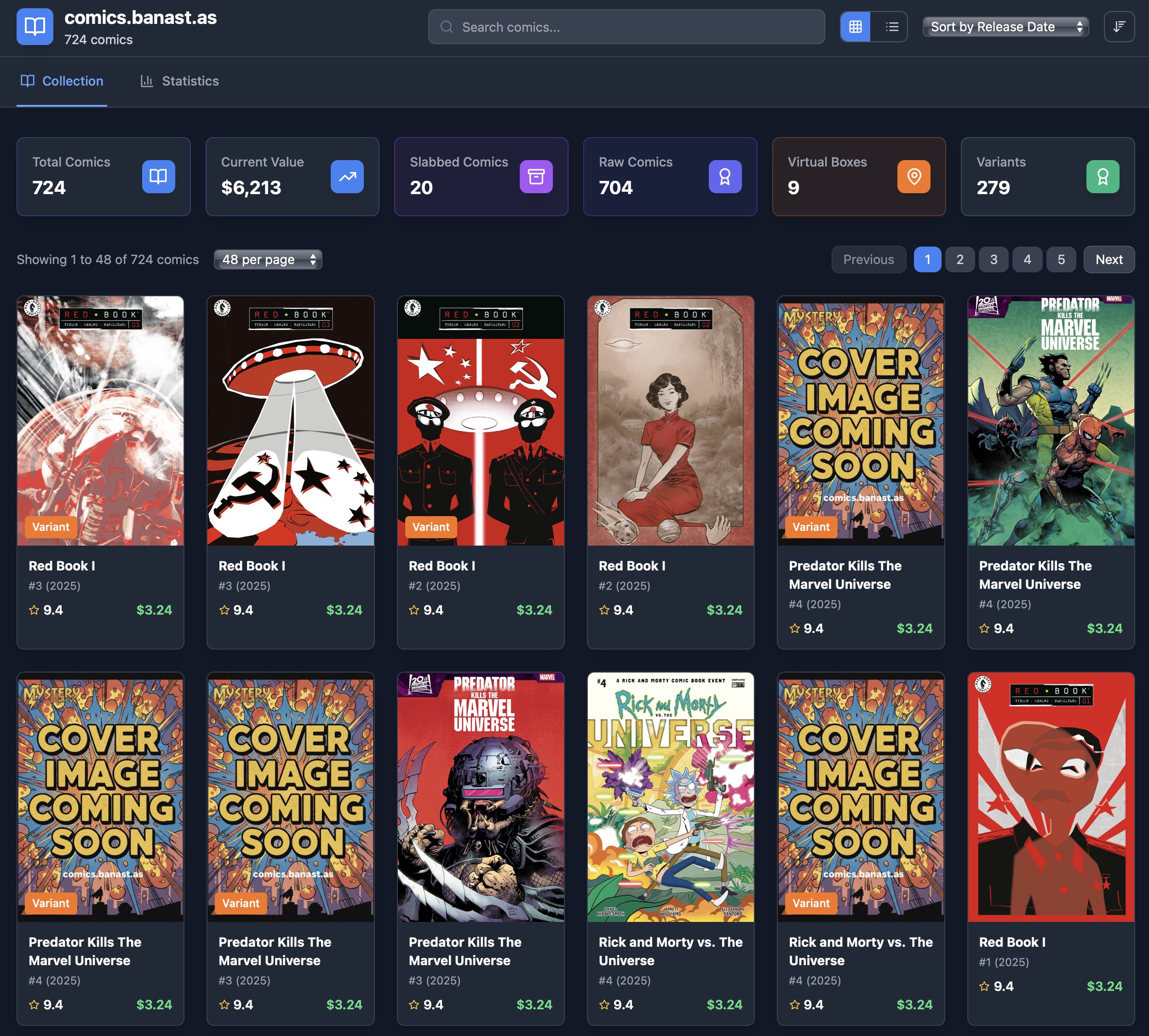
So I started building a personal, self-hosted comic collection tracker. Not a CovrPrice clone. Not a startup. Not a grand platform. A tool for the way I actually maintain this archive.
The app tracks titles, issue numbers, variants, cover images, condition, slabbed versus raw books, current values, and where things live in the collection. It gives me search, sorting, basic stats, and a faster add flow. It is built around the maintenance habit, not around the fantasy that someday I will sit down and lovingly enter metadata for an entire afternoon.
I built it with React, TypeScript, and Tailwind CSS. I also added a simple n8n workflow that updates the site’s main JSON file whenever I add new purchases to a Google Sheet. The next step is probably triggering that automatically from email order receipts from places like MidTown Comics, because that is where the workflow actually starts.
The value-tracking part is intentionally modest. I list current values for each comic, but I do not have it tied into a pricing system. I experimented with pulling spot averages from eBay listings, but exact issue matching, variants, and condition made that messy fast. It would be interesting to solve eventually, but it is not the point. Organization matters more to me than automating estimated resale values.
Once I had the build stable enough for my own use, I made the repo public and released it as open source: github.com/banastas/comics.banast.as
Why personal archives need personal tools
An inventory stays useful only if it stays accurate. Reducing the effort needed to add a purchase makes me more likely to keep it current.
That is also the concern behind the photography workflow posts. The system needs to be easy enough to maintain for years, including when the collection grows or the software changes.
It is also why this now sits next to the same argument I make in Build on Your Own Land: the canonical version of something you care about should not depend entirely on someone else’s interface.
Building your own tool is not always efficient. Sometimes it is a ridiculous use of time. Sometimes the mature commercial product is better, cheaper, safer, and absolutely the right answer. I still use plenty of rented tools because I enjoy having a life.
My collection has personal history as well as financial value. I want a tool that makes it easy to find a book, check whether I own an issue, and record a new purchase.
Open sourcing the app does not make it universally useful. It makes it inspectable. It makes it reusable if someone has a similar need. It means the thing I built for my own collection is not trapped inside my own private setup. That is enough.
The app succeeds for me if I keep using it when new comics arrive. That is the practical test: whether the next update is easy enough that I actually do it.