
Given the current state of social media, a network built around one specific thing feels almost suspiciously sane. It is not trying to become the whole internet. It is not trying to train me into a permanent state of low-grade political panic. It is not, as far as I can tell, built primarily to influence elections. It is just movies.
I am sure there are other focused networks like this that I either do not use or have never heard of. The two that come to mind immediately are Untappd and Letterboxd. Untappd was fun for a while, but with my beer intake reduced to almost nothing as a general “feel better” rule during the pandemic, I have not exactly been chasing new badges for hazy IPAs.
So Letterboxd wins by default, and also not by default. Letterboxd is truly the only social network I love.
That is partly because it stays narrow. Letterboxd does not need to know everyone from high school. It does not need to host my family arguments, breaking news, recipe videos, brand apologies, and whatever rage machine happens to be idling that day. It has one domain, movies, and it makes the social layer useful instead of exhausting: logging, ratings, reviews, lists, stats, recommendations, and seeing what people with interesting taste are watching.
I do not know what part of my personality makes me so happy to track things, sort things, and turn habits into little personal data sets, but Letterboxd is extremely good at feeding that part of my brain without making it feel gross.
The site has replaced IMDb for me for quick lookups when some film detail escapes me: cast, crew, release year, runtime, where I know that actor from, whether I am remembering the title correctly, all of it. But it also has a vibrant community of people who actually love films, which is the part that makes it feel alive rather than just useful.
The logging is especially cool, not because I am in constant danger of forgetting every movie I have ever watched, but because the record becomes valuable later. A single diary entry is not much. Years of entries become a map. You can see what you watched, when you watched it, what you thought then, what you were circling back to, and which obsessions quietly became permanent. Letterboxd turns watch activity into memory.
Stats
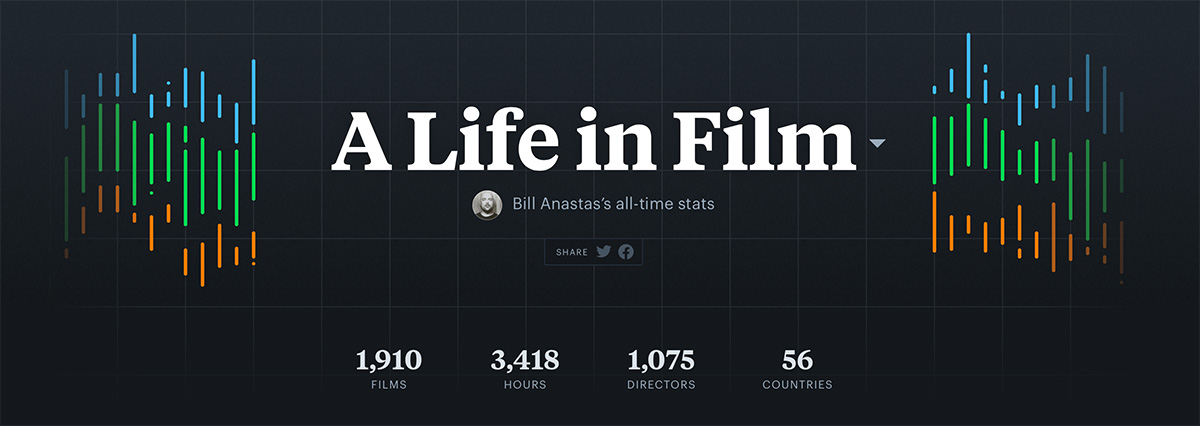
At any point, overall or for any year that I have data on, I can take a deep dive into my viewing habits and see what I liked best that year, how many films I watched and when, and breakdowns by genre, director, actors, crew, and country of origin.
That sounds dry, but it is not dry when it is your own taste staring back at you. The stats make patterns visible: which directors I keep returning to, which actors show up constantly, whether I am watching older films or new releases, whether a month was all comfort rewatches or a weird little international detour. It is analytics in the useful sense. It shows taste over time, not productivity.
At the start of each new year, Letterboxd also sends a beautifully designed report of the previous year’s watching habits and totals. It gives the year a shape. Here is what I watched. Here is what stuck.
Lists
OK, this is where things get a little crazy.
I started making lists of people and franchises I really liked, first to see how much of their work I had actually seen, and then to learn what I had missed.
- Quentin Tarantino (90% watched)
- Steven Seagal (75% watched)
- Alien Universe (100% watched…and then some)
- Keanu Reeves (41% watched)
- The Work of Stan Winston (48% watched)
There is a very particular satisfaction in taking some vague feeling like “I have seen a lot of Keanu Reeves movies” and turning it into an actual number. Sometimes the number confirms the feeling. Sometimes it tells you that you have homework.
Then I went a bit further and made lists based on Oscar wins going as far back as the categories existed.
- Best Picture Winners (1929-Present) (37% watched)
- Best Animated Feature Winners (2001-Present) (63% watched)
- Best Visual Effects Winners (1963-Present) (67% watched)
The list feature works beautifully for this because it is not just a static page of titles. Letterboxd knows what I have watched, so I can fade out the films I have already seen and turn a list into a to-do list without manually maintaining a second version of it.
Once that clicked, I started making more personal and much less defensible lists, like “Movies I can’t stop watching no matter what point I start watching them.” (100% watched) and “The Films That Raised Me” (100% watched).
Those are the lists that make Letterboxd feel less like a database and more like a notebook. It is not only what I have seen. It is what I return to, what shaped me, what I use as comfort food, and what I want to close the gaps on.
Media Library
Lists are functional for me beyond the social and obsessive parts. I also keep two separate lists tied to my media library and purchases I have made through iTunes or Movies Anywhere.
That matters because the actual question is not always “what should I watch?” Sometimes the better question is “where can I watch the thing I already own?” Between a personal media library, Apple purchases, Movies Anywhere, streaming apps, and whatever licensing chaos is happening that week, browsing can become strangely inefficient.
Letterboxd gives me a bridge between taste and access. I can keep a running sense of what I want to watch, what I own, and what I should stop pretending I am going to remember later.
Letterboxd also has an Apple TV app that is equally well designed. This is my preferred method of figuring out what I should watch next and then knowing exactly where to look for it.
Add me!
(But, like, not in the creepy Facebook way.)
Letterboxd works because it knows what it is. It does not need to be the place for everything. It just needs to be the place where watching movies turns into memory, taste, lists, stats, and the occasional extremely correct five-star review.
It is my favorite social network because it barely feels like one. It feels like a notebook for movies that other people happen to be writing in too.