I keep notes on talks I think will matter later. One of them is Jeremy Rifkin’s The Third Industrial Revolution, a VICE documentary released in 2018 in which he spends an hour and forty minutes telling a room of young people in Brooklyn what the next few decades will look like.
His argument was simple and confident. Renewable energy, driverless transport, and the internet were converging into one platform. On that platform the cost of making one more unit of almost anything would fall toward zero. And because the platform was distributed by design, the gains would go to cooperatives, small businesses, and ordinary people instead of to giant vertically integrated companies.
I went back to the note this week and checked it against what happened.
He got the price right. He got the owner wrong.
The price
On cost, Rifkin was right, and in places he was too cautious.
He told the room that a watt of solar had gone from $78 in the late seventies to about fifty cents. Chinese-made panels now sell for about eleven cents a watt. He said Germany would pass a third of its electricity from renewables by 2020. Renewables covered about 56 percent of German electricity use in 2025.
He said driverless vehicles were coming. Waymo now reports more than 500,000 paid rides a week, and Baidu’s Apollo Go has passed 20 million rides in China.
Anyone who bet against those curves lost.
The owner
The other half of the prediction was about who would hold the new machinery, and that half did not happen.
Start with Germany, his best example. He described thousands of electricity cooperatives, farmers, and neighborhood associations borrowing against guaranteed prices and taking the market away from the four big utilities. That was true when he said it. Then the guaranteed prices gave way to auctions, and auctions favor whoever has the cheapest capital. By 2019, private individuals were no longer the largest group of owners of new plants, and the citizen share of German renewables had slipped to about a third.
Transport went the same way. He expected car sharing to remove most of the world’s vehicles and expected my generation to stop owning cars. The driverless cars arrived, but they are fleets owned by Alphabet and Baidu. You do not share them with your neighbors. You rent a seat from a corporation.
The sharing economy he called the first new economic system since capitalism and socialism turned out to be capitalism with an app. Daimler’s truck platoons, which he held up as the future of logistics, were shelved in 2019 because the company found no business case.
And the incumbents he said were finished are not finished. He told the room that OPEC had wiped out American shale. The United States produced a record 13.6 million barrels of crude a day in 2025, more than any country ever has.
Cheap to run is not cheap to own
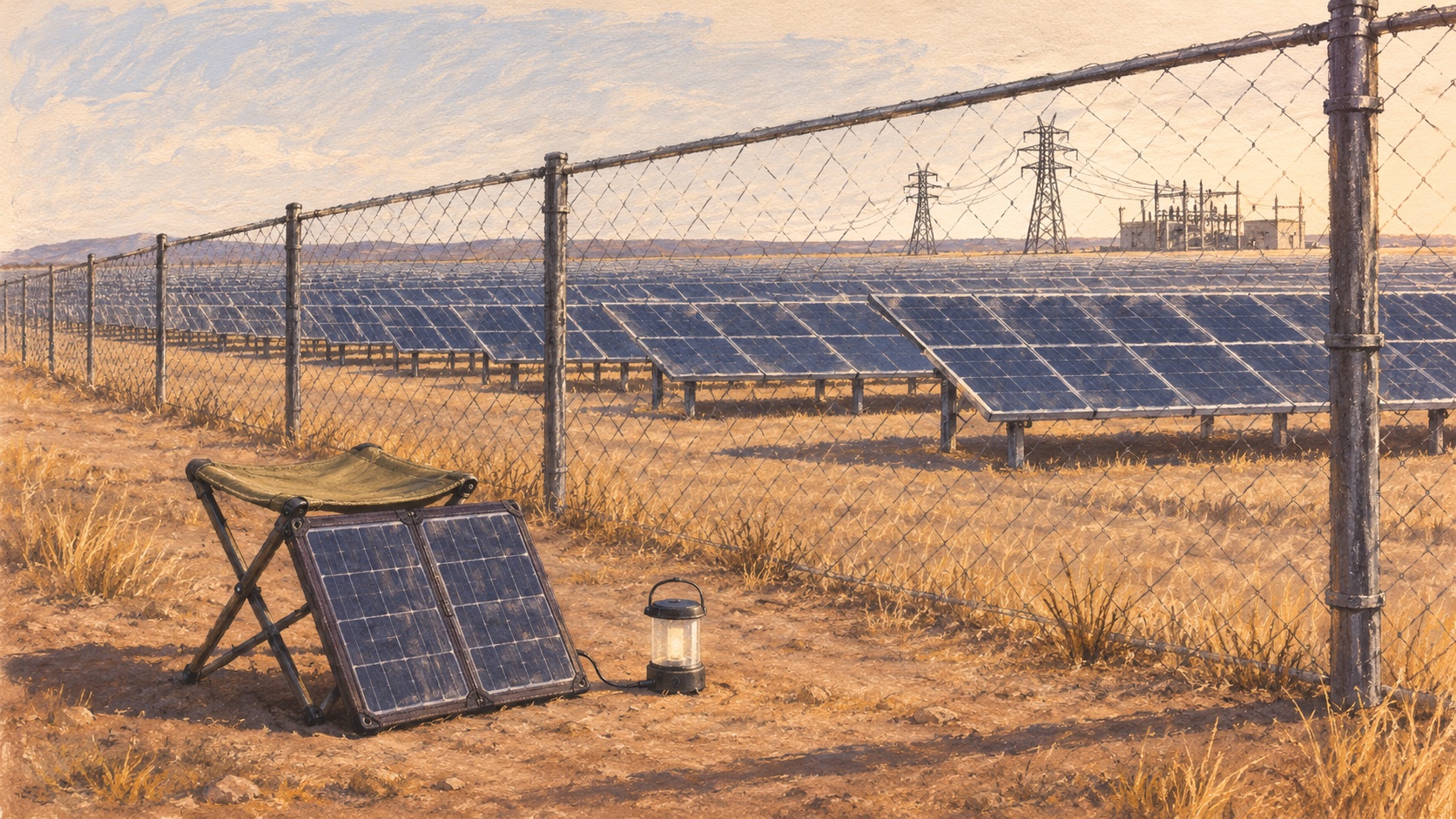
The mistake underneath all of this is in one line he delivers with real pleasure: “The sun has not sent us a bill in Germany.”
That is true, and it is the wrong bill to look at.
Marginal cost is what one more unit costs after everything is built. Sunlight is free. The panels, the transmission lines, the batteries, and the backup plants for a windless week in January are not. Those are fixed costs, and whoever pays them owns the system and sets the price.
German households paid the highest electricity prices in the EU in the first half of 2025. The sun still has not sent a bill. The grid operator has.
When the running cost of something falls to nothing, the value does not spread out evenly. It moves to whatever is still scarce and expensive, which is usually the infrastructure. A world of zero marginal cost is a world where the fixed costs are the whole game.
He saw it coming
Rifkin deserves credit for a part of the talk that gets less attention. He spent several minutes on what he called the dark side of the platform: governments capturing it, a few internet companies using everyone’s data for their own ends, and the need to regulate Google and Facebook as public utilities. He said his audience would spend their lives fighting that fight.
He treated it as a risk to be managed on the way to the main event. It turned out to be the main event.
The same story, faster
The cleanest test of his idea is one he did not see coming.
The marginal cost of cognitive work is collapsing right now. A first draft, a summary, a block of working code, a rough storyboard: each costs a small fraction of what it did when ChatGPT launched. Stanford’s AI Index found that the price of output at that level fell 280-fold in under two years. That is zero marginal cost crossing into a new part of the economy, exactly the event he described.
It is also the most centralized technology of my lifetime. The models run in data centers that cost tens of billions of dollars each. Bloomberg put one gigawatt-scale site in Abilene, Texas at roughly $30 billion, and Epoch AI estimates it will need as much electricity as the population of Seattle. Almost nobody can afford one. The cheap thing is the answer. The expensive thing is the building the answer comes from, and a handful of companies own the buildings.
I wrote in Build on Your Own Land that the mistake is confusing distribution with ownership. Rifkin made the same mistake at the scale of an economy. He saw that everyone would be able to use the new platform and concluded that everyone would own it.
Where he was right
His version does exist. It is small, and it is worth noticing where it shows up.
It shows up where the fixed cost is low enough for one household to pay it. Germans have registered more than a million solar kits that plug into a balcony socket. Pakistan added 27 gigawatts of distributed solar in three years as customers walked away from an expensive, unreliable grid. A language model that runs on the laptop you already own.
In each of those cases the person who uses the thing also owns the thing. That is the condition his prediction needed, and it is the condition he assumed instead of checked.
The ownership question
When someone tells you a technology will make something nearly free, cost is the wrong thing to argue about. They are probably right about cost. Ask these instead:
- What still costs real money after the running cost hits zero?
- Who is paying for that part?
- Can a person, a small company, or a town afford to own a piece of it?
- If not, who rents it to them, and on what terms?
- What happens to the people who depend on it when the terms change?
I use the cheap answers every day. I am not going to stop, and I do not think anyone should. In Friction Is About to Become a Luxury I argued for keeping the steps that carry judgment. This is the same argument about property. Use what is cheap. Know who owns what it runs on. Own the parts you can.
Rifkin told that room the sun had not sent a bill.
Somebody always sends the bill. The useful question is who.