This essay was adapted into Episode 001 of The Decision Layer.
A room full of bad options is not that dangerous.
Bad options usually die on their own. The ugly frame. The dead line. The confusing cut. The campaign route nobody believes in. The AI image that looks expensive and says nothing. You do not need much courage to reject something that clearly failed.
The dangerous options are the ones that almost work.
They are polished enough to defend. They solve one visible problem. They photograph well in the meeting. They make somebody feel heard. They preserve flexibility. They keep a stakeholder calm. They are not embarrassing. They are not useless. They are simply wrong.
That is where production actually begins.
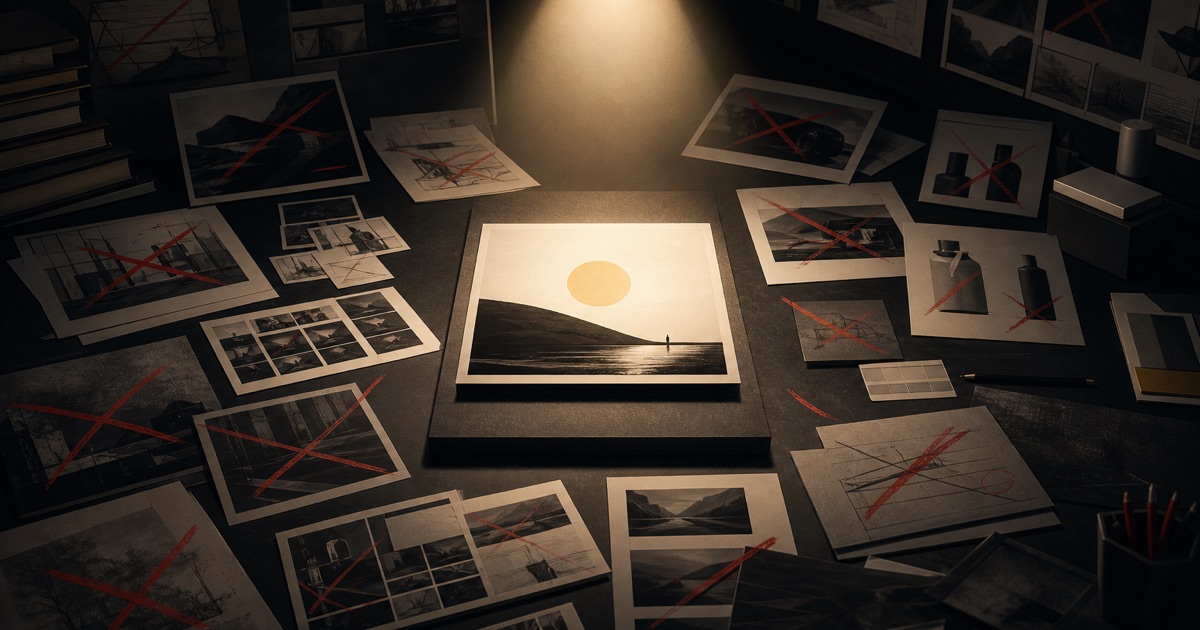
Production is not the generation of possibilities. Production is the disciplined destruction of plausible alternatives until one thing can survive contact with reality.
This is the part people outside production often misunderstand. They think the job is to create more choices. More boards. More versions. More edits. More lines. More prompts. More treatments. More thumbnails. More options to explore.
Exploration matters. But exploration is not production.
Production is where almost-good ideas go to be murdered, if the adults are doing their jobs.
Almost-good is worse than bad
Bad ideas tend to die quickly because nobody needs a coalition to reject them.
Almost-good ideas attract defenders. They get constituencies. They become compromises. They hang around because killing them feels slightly unfair. The frame is beautiful. The line is clever. The cut is smoother. The deck is accurate. The feature works. The AI concept is impressive. The route is safe. The note has technically been addressed.
The problem is that almost-good usually solves the wrong thing.
It solves the meeting. It calms the room. It gives the team something to point at. It keeps the conversation moving. It makes the stakeholder feel like the note landed. It creates a path where nobody has to be fully wrong yet.
But the work gets weaker.
Almost-good is the option that solves the meeting and hurts the piece.
That is why it is so hard to kill. If an option is obviously bad, rejecting it feels like taste. If an option is almost-good, rejecting it can feel like aggression. Now someone has to explain why the expensive-looking thing is not the right thing. Why the safer version is weaker. Why the clever line breaks the voice. Why the shot that everyone likes does not help the scene. Why the beautiful image has no job.
This is not about being precious. It is not about protecting some fragile artistic purity from the dirty realities of production. It is the opposite. This is about the dirty reality of production.
A real thing has to ship, air, screen, post, sell, teach, persuade, land, or survive. It has to leave the room and meet people who did not sit through the process. Those people will not care how many options were explored. They will not reward the internal politics of compromise. They will not see the Slack thread, the notes doc, the alternate boards, or the prompt history.
They will only meet the thing that survived.
Creation expands. Production narrows.
Creation and production are related, but they are not the same job.
Creation asks: what else could this be?
Production asks: what is this actually going to become?
Creation benefits from looseness. Production punishes looseness. Creation opens doors. Production closes most of them. Creation expands the map. Production burns the roads that lead away from the point.
This is why the production phase can feel brutal if everyone still thinks they are in exploration mode. Exploration wants permission. Production needs commitment.
At some point, the work has to stop being a cloud of possible versions and start becoming one version with consequences. That is uncomfortable because consequences are where taste stops being theoretical.
It is easy to have opinions when everything is still reversible. It is harder to choose when the choice means another plausible path dies.
That is the job.
The director chooses the shot. The editor loses the pretty take. The producer cuts scope. The designer removes the clever feature. The writer deletes the line everyone likes. The VFX supervisor says the shot is technically solved but dramatically pointless. The agency lead rejects the safe route. The founder ships the smaller thing that actually knows what it is.
Not because options are bad. Options are useful. They are how you learn the shape of the problem.
But options are temporary scaffolding. They are not the building.
If you leave the scaffolding up too long, people start designing around it.
AI industrialized plausible
AI did not invent the almost-good option. It industrialized it.
That is the real production risk. Not that the machine makes bad work. Bad work is manageable. Bad work can be rejected quickly. The problem is that AI makes polished, plausible, almost-good material at a volume that can drown the judgment needed to make anything specific.
The cost of generating alternatives used to be visible. You needed people, time, money, render hours, shoot days, edit sessions, boards, revisions, or at least enough friction that the number of options had a natural ceiling.
Now a lot of that cost has moved downstream.
The option is cheap. The judgment is not.
You can generate the image, rough the storyboard, draft the line, mock the interface, build the deck, create the campaign route, summarize the meeting, remix the reference, and produce a convincing little object faster than ever.
That is useful. I like useful.
But plausible is not the same as chosen.
A plausible AI image can still have no dramatic obligation. A plausible strategy slide can still avoid the actual decision. A plausible product mockup can still muddy the workflow. A plausible voiceover can still sound like nobody. A plausible visual direction can still be a collection of references instead of a point of view.
The danger is not that teams will mistake garbage for finished work. The danger is that teams will mistake plausibility for progress.
Plausibility gets you into the meeting. Production decides what deserves to leave it.
Good, but wrong
The adult in the room is not always the most creative person. Sometimes it is the person willing to say: this is good, but wrong.
Good, but wrong.
Beautiful, but wrong.
Expensive-looking, but wrong.
Clever, but wrong.
Useful in the meeting, but wrong for the work.
Impressive, but with no job.
Safer, but weaker.
That kind of judgment is easy to caricature as negativity. It is not negativity. It is protection.
Every almost-good option that stays alive takes up space. It changes the shape of the conversation. It bends the next decision. It gives people something to hedge against. It makes the final thing less final.
You can see this in edits where every good moment has been protected until the scene has no rhythm. You can see it in decks where every point survived and none of them matter. You can see it in products where every reasonable feature made it in and the workflow disappeared. You can see it in campaigns that satisfy every note and leave no bruise. You can see it in AI work that looks finished before it has ever been forced to mean anything.
The problem is not abundance. The problem is cowardice disguised as abundance.
More is only useful if someone is willing to make less.
The work needs a center of gravity
The point of killing almost-good options is not to make the process harsher. It is to give the work a center of gravity.
A scene cannot be about everything. A campaign cannot satisfy every fear. A product cannot serve every hypothetical user. A deck cannot preserve every nuance. A shot cannot carry every intention. A brand cannot be all adjectives at once. A piece of writing cannot keep every sentence that once made the writer feel smart.
Something has to matter most.
Once you know what matters most, the almost-good options start to reveal themselves. They are the ones that pull energy away from the center. They flatter the process instead of strengthening the result. They are defensible in isolation and damaging in context.
That last part matters. Almost-good options often look fine by themselves. Sometimes they look great by themselves. The test is not whether the option has quality. The test is whether it belongs.
A beautiful shot that breaks geography does not belong. A clever line that breaks voice does not belong. A stronger image that weakens the story does not belong. A safer note that makes the work generic does not belong. A feature that works but confuses ownership does not belong.
Production is not a museum of everything that could have worked.
Production is a sequence of necessary deaths.
The test
The test is simple: if we keep this, what does it make clearer?
If the honest answer is “it gives us options,” kill it.
If the answer is “someone liked it,” kill it.
If the answer is “it covers us,” kill it.
If the answer is “it might be useful later,” kill it.
If the answer is “it looks expensive,” kill it.
If the answer is “it solves the note,” ask what it breaks.
If the answer is “it makes the work sharper,” keep going.
That is the difference between activity and production. Activity can generate possibilities forever. Production has to choose what survives.
The finished thing is not the pile of everything that could have worked. It is what remains after the almost-good options are dead.