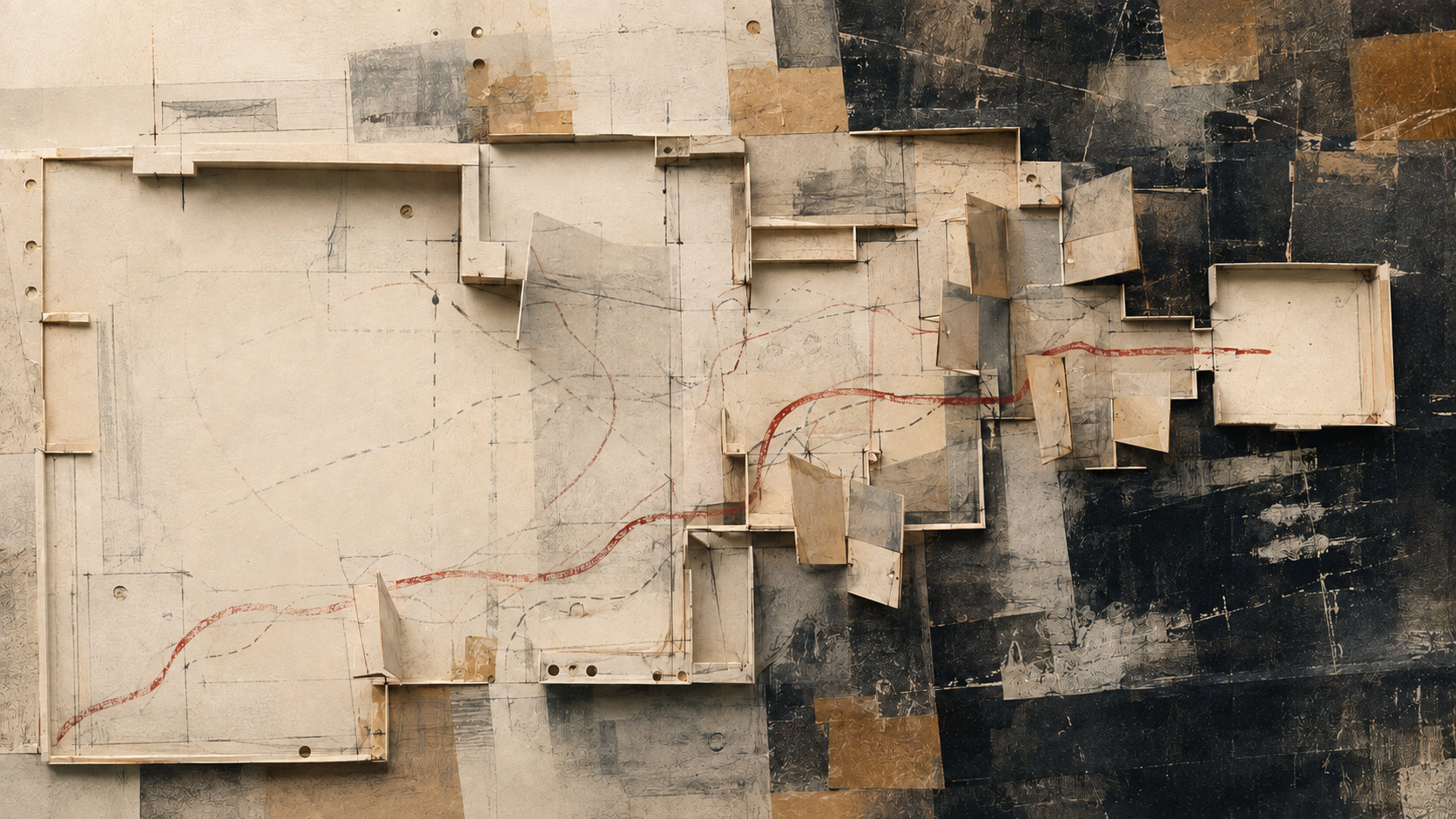
Action movies are floor plans under stress.
That sounds like a small craft note until you watch how many action scenes fail without it. The stunt can be expensive. The camera can shake in all the right places. The edit can cut fast enough to imply danger. Someone can jump, crash, punch, run, shoot, fall, recover, and keep going.
But if the audience does not understand the space, the action has no pressure. It has movement.
A good action scene teaches the room before it attacks the room: exits, doors, bad routes, clocks, blind spots, bodies, walls, traps, and what changes when the place stops being neutral.
That is why Die Hard still works as the clean example. Nakatomi Plaza is not just a tall building where action happens. It is the action system.
Nakatomi is a machine
The party matters because it establishes the building as social space before it becomes tactical space. Elevators are convenience. Offices are status. The vault is corporate infrastructure. The roof is just the roof.
Then the takeover changes the meaning of every piece.
The elevators become routes and traps. The floors become layers of risk. The roof becomes a promise and then a problem. The vault becomes the real objective. Radios turn distance into conversation. Glass turns a hallway into a weapon.
That is the craft. The script teaches the building, then lets the building change sides.
John McClane is not interesting because he is invincible. He is interesting because he is under-mapped. He is loose inside a system that Hans Gruber thinks he controls. The movie keeps re-pricing the floor plan. A stairwell is safe until it is not. A radio is power until it exposes you. A hostage floor is stable until one person is missing. A roof is salvation until it becomes a killing field.
The action works because we can feel the map becoming a clock.
Containment is not just geography
Contained action does not mean small. It means rules.
The Nostromo in Alien is a ship, but the ship is not the point by itself. The point is quarantine. A closed door is not just a closed door. It is a moral test. In the Kane airlock sequence, the arena is the threshold: if the contaminated body stays outside, the crew has a chance. If the body comes in, the whole ship changes category. It stops being workplace, home, vehicle, and shelter. It becomes a body system with bad rules.
The scene works because safety protocol collides with fear, loyalty, labor, and corporate logic. The arena is not only metal corridors. It is the question of who gets to breach the rule and who pays for it.
Jaws does the same thing in the open air, which is harder. Amity is not a claustrophobic spaceship. It is a town, a beach, a season, a tourism economy, a mayor, a police chief, and a public narrative that cannot afford proof. The shark works before it is seen because the town is built to disbelieve danger.
The beach is geography, but the pressure is civic. Where can people swim? What can be closed? Who has authority? What counts as evidence? How much money does truth cost this weekend?
That is why the first half of Jaws is not filler before the boat. It teaches the arena. By the time the movie moves onto the Orca, the ocean is not just water. It is distance, appetite, expertise, panic, weather, machinery, and bad information.
Jurassic Park earns its spectacle the same way. The park is sold as control: fences, locks, tour cars, maps, paddocks, visitor routes, command rooms, and protocols. Then the storm and Nedry’s sabotage turn that control system into a liability map. The T. rex attack is not only a dinosaur set piece. It works because the movie has already priced the fence, the stalled cars, the glass, the mud, the drop, the missing radio contact, and the lie that the humans still understand the system they built.
That is probably enough Jurassic Park. The kitchen scene is another clean example, but adding both would tilt the essay toward Spielberg case studies instead of the broader rule.
Rooms have politics
The best version of this idea is not limited to traditional action movies.
Parasite turns a house into a class diagram. Stairs, windows, smell, rain, and basement access are not production design decoration. They are the movie’s argument made physical. The Park house works because status has an up and a down. Privacy has a door. Labor has a smell. Shelter depends on who owns the architecture.
When the basement is revealed, the house does not simply gain a new location. The map reverses. A clean modern home becomes a vertical system of dependency, concealment, fantasy, and rot.
The Menu does it with service. Hawthorn is a restaurant, but the menu is a plot outline disguised as hospitality. Each course teaches a new rule. Each ritual narrows the exits. The room starts as luxury and becomes containment. Service becomes surveillance. Taste becomes obedience. The chef’s authority is not abstract; it is built into where people sit, when food arrives, who may leave, and how the staff moves as one body.
That is what people mean, or should mean, when they talk about strong worldbuilding. Not lore. Not backstory. Not proper nouns. Rules.
A place is dramatic when its rules can hurt you.
Spectacle is rehearsal
Top Gun: Maverick is useful because it is so explicit about this. The mission works because the movie makes the audience rehearse it before the final run.
Altitude. Turns. Target. Climb. G-force. Timing. Wingman survival. The impossible route is explained so many times that by the end we are not just watching jets go fast. We are reading the attempt against rules we understand.
That is why the final sequence has pressure. We know what too high means. We know what too slow means. We know what missing the climb means. We know why one pilot’s success can still doom another pilot. The movie sells the miracle because it first teaches the procedure.
Bad spectacle skips that step. It throws scale at the audience and hopes impact will substitute for comprehension. More vehicles. More debris. More bodies. More cuts. More money on screen. None of that matters if the viewer cannot tell what changed.
Action is not the presence of activity. Action is pressure on a readable system.
Scripts are systems
Plot summary flattens this into what happens. Script analysis should be able to show how the pressure is built.
A script is not just dialogue and scene order. It is a map of pressure. It tells you what the arena is, which institution controls it, what rule gets violated, what the cost is, which entrance changes the room, when the map reverses, and what the audience has to learn before the turn lands.
That is the direction of the OverBlack work: scripts as systems you can query by craft function, not just title, decade, genre, or writer.
Can I find scenes where a house becomes an institution? Where a route becomes a clock? Where a body becomes evidence? Where a restaurant becomes a trial? Where a public beach makes proof politically expensive? Where a mission briefing teaches spectacle before cashing it in?
That is more useful to me than another archive of famous lines. Lines matter. Plot matters. But craft often lives in the relations between place, rule, pressure, and cost.
The room has to fight back.
The test
Here is the simple test for an action scene: can you describe the arena’s rules before the scene breaks them?
If you cannot, you probably do not have pressure yet. You have bodies moving through a location.
Where are we? Who controls the space? What route is safe until it becomes dangerous? What object changes meaning? What happens if the door opens? What happens if it does not? What gets more expensive as time passes?
That is the work underneath the punch, chase, shootout, crash, climb, meal, landing, ambush, or escape.
The stunt is the visible part. The floor plan is the pressure system.
Teach the space. Break the rule. Make the room fight back.