From 1996 to 2001, I worked at Dunkin’ Donuts in Quincy, Massachusetts.
I started with the 6 a.m. to noon shift on weekends in high school, then picked up more hours over summers and breaks through my senior year of college. I worked every shift the store had, from opening at 4 a.m. to closing at 11 p.m.
It was not a cute first-job story. It was five years behind a counter in a town where everyone eventually came through the drive-through: commuters, cops, politicians, regulars, addicts, rich assholes, broke assholes, kind people, desperate people, and people who covered several categories before breakfast.
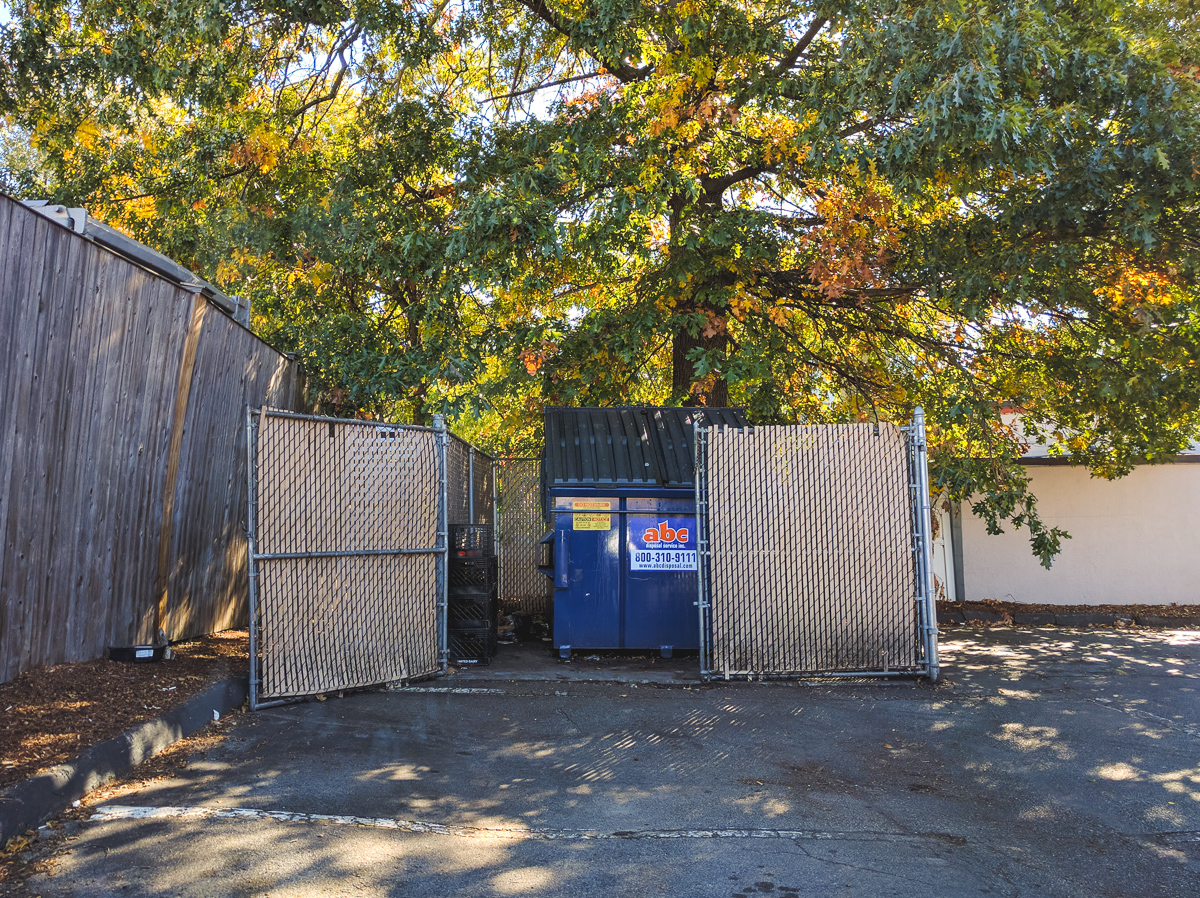 I threw more trash in this dumpster than any other since
I learned how to pour coffee and work a register, sure. Mostly, I learned how unofficial systems work: who gets charged, who doesn’t, which rules matter, which rules are theater.
1. Avoid Filled Donuts at All Costs
When I first started, before anyone trusted me near a drive-through headset, I used to make the donuts. Technically, I finished the donuts. We had no oven on premises. One baking store supplied five or six satellite stores with unfinished donuts.
The guy who made those deliveries was super nice and always on time. I found out later that he had been caught skimming from the registers a couple years earlier. From what I understood, the owners let him work off the debt instead of involving the law, provided he did the job well. He did.
I liked finishing donuts because it gave me an hour away from the rush to focus on my frosting skills, which were not nothing.
There was one warning a coworker gave me that I came to believe completely: never, ever eat a filled donut. There is nothing metaphysically wrong with one. The problem, at least in our store at that time, was the preparation.
The fillings came in large, funnel-like plastic cartridges that fit into a machine. To make jelly donuts, you pulled the cartridge off the shelf, set it into the machine, stabbed the donut shells with the spigots, and clicked the fill lever.
The cartridges were pretty well sealed. The spigots were not. They were supposed to be washed after each use, but they also held as much filling as they were long, which meant following the guideline would waste a ton of filling. In practice, they sat on the shelf with spigots attached and exposed filling oozing out between uses.
We only finished donuts once a day. That meant sugary filling could sit in open air before being fired into the next day’s donuts. I am not making a universal claim about Dunkin’ policy or food science. I am saying what I saw.
In college, I had a professor miss class for a few days. When he came back, he said he had food poisoning. The culprit, he believed, was a jelly donut he had waited a day to eat. I said nothing, but felt like I knew.
Aside #1: The Customer Can Still Hear You
When we were short-staffed and a rush hit, the manager would come out of the office and work the counter. The space between the register and the donut case was only a couple feet wide, but he seemed to believe that as soon as he turned his back, the customer could no longer hear him. Either that, or he did not care.
This happened more than once:
-
Facing the customer:
“Hi, how are you today? What can I get for you?”
-
Facing the donut case:
“I’ll get you a donut you fat fucking cunt - I hope you choke on this and die you dumb shit.”
-
Facing the customer:
“Would you like anything else today? How about a fresh-brewed iced coffee?”
The amazing thing is that I never saw him get caught. Maybe he had calibrated the exact volume required to be monstrous in private while appearing normal in public. It did not look scientific.
It taught me that service friendliness can be paper-thin. Also, customers can still hear you.
2. The Unwritten Rules of Free Coffee
At the time, Dunkin’ franchises had one of the most liberal employee food and drink policies I have seen. On shift, an employee could drink any coffee product, except a Coolatta, and eat anything from the donut case.
Management also instructed us never to charge a few local politicians who came in from time to time. I assume this was some weird attempt to bank political goodwill through medium regulars.
Once those ideas were in place, I started applying my own logic.
Any coworker who came in off shift was not being charged by me. If I came in off shift, I would not bother the person working. I would walk behind the counter in street clothes, make coffee to my exacting standard, and walk back out with nothing more than a nod.
Then there were the super-regulars. Plenty of people came in at roughly the same time every day, but these were the ones you were genuinely happy to see. They were kind, patient, tipped, and treated the person at the window like a person. I decided they were not paying either.
One guy drove a white Jaguar, and later a light-blue one, that we recognized immediately. All he had to do was say “hello” into the box and his coffee would be waiting by the time he pulled up. He offered to pay every single time. Every single time, I told him, “Not a chance.” He would put a buck in the tip cup, thank us, and drive away.
Eventually I trained other people on this rule. The Jaguar guy did not pay for coffee. Even the manager’s son honored it without knowing who the guy was or why he mattered.
This became part of my operating system later. When I find a bar I like, which is not often, I over-tip. By over-tip, I mean excessively tip. People who work for tips should take care of people who currently work for tips.
Also, I have drunk more than I could ever have paid for this way. That is not the reason, but I would be lying if I said it was not an outcome.
3. Addiction Is a Powerful and Terrifying Thing
Quincy and the surrounding parts of Boston have always had a tough time with addiction. Over those years, I encountered more heroin addiction and casual crack use than I knew how to process. One Saturday made it impossible to treat as background noise.
I worked for a couple months with a woman someone told me was 26. I remember being shocked because she looked much older. That is not a punchline. She was carrying damage I did not yet have language for.
She came into work one Saturday morning seeming off. She was working the drive-through, and at random she would reach into the next customer’s bag, take a quick bite of food, then hand it out the window. Obviously that was not okay, but nobody understood what was happening yet.
When her break came, she left and disappeared. People thought it was weird, but not impossible. Weird things happened there.
I was working a double that day, 6 a.m. to 6 p.m., to cover for a friend. Around 3 p.m., I took out the trash and saw her walking toward me in a completely new uniform.
She looked at me and said, “What the hell are you doing here?”
I told her I was working a double.
She said, “No seriously, stop fucking with me - what the hell are you doing here?”
After a few more words, I realized she thought it was the next morning and that she was arriving for a 6 a.m. shift.
I brought her inside. She was distraught and still not convinced of the time. I sat her at a table and gave her water. Eventually she said she felt better and left.
Soon after, a creepy guy in a rusty pickup truck started circling the store. He came inside and asked for her. We told him she had already left.
About an hour later, they were both back, with the police about a minute behind them. She was arrested in front of the counter for allegedly stealing the tip jar at a nearby store. The guy in the rusty pickup, who by then we assumed was her boyfriend, saw it and took off before the cops saw him too.
I do not know what happened to either of them after that. I hope they got clean. I hope something interrupted whatever was happening before it finished the job.
Aside #2: Heroin Isn’t the Only Thing That’s Bad for You
I worked the drive-through all the time. The two people on it were the busiest people in the store for the entire shift, but time passed quickly and the tips were good.
There was an older couple in a beat-up minivan I recognized as regulars. They usually ordered two coffees and a dozen donuts. I had not realized until one day that the dozen donuts were for them, right then, in the van.
As I rang them up, I saw one of them in the passenger seat lift up their shirt and inject insulin into their stomach.
My counterpart passed them the food as I got their change. By the time I reached out with it, they had already eaten two donuts from the box.
I could not bring myself to eat another donut for years after that.
That was the first time I felt like a drug dealer selling coffee and donuts. I was not happy to be further poisoning the world, but what are you gonna do? It is legal lethality.
4. Don’t Be an Asshole, Even If You Own the Place
The couple that owned our store, along with about five others nearby, came in from time to time to check on things.
The wife always seemed to arrive directly from riding her horse. I do not think I ever saw her wear anything other than riding pants, which prompted the manager to joke that she would beat him with a riding crop if he messed something up. I did not think he was entirely joking.
The husband came in less often, but when he did, it was a show.
We had a short row of two-person tables. Looking out from the counter, he would sit at the one farthest to the right, directly underneath the No Smoking sign. The manager would bring him coffee and the books, and the owner would light up a cigar.
He would sit there for at least an hour going through cash reports while customers complained about the smoke. But he owned the place, so what are you gonna do? I am not even sure he liked smoking that much. He seemed to like smoking there because people did not want him to.
I found out a few years ago that he was charged in a conspiracy to defraud the IRS, so maybe there was more going on than I knew at the time.
The lesson was not subtle. Ownership can make petty people feel consequence-proof, until it doesn’t.
5. Messing with Cops You Kinda Know Is Still Probably Not Smart
The stereotype is not entirely wrong. Quincy cops came in for coffee all the time, and they were firmly in my “never charge, ever” category.
The local cops all knew us. My best friend, to this day, worked at Dunkin’ at night and as a mechanic during the day, usually outfitting cop cars. Because of that, he was practically untouchable. One detective friend once told him, “If you ever get into trouble - as long as you’re not selling drugs to kids or beating up your wife, give me a call and I’ll take care of it.”
One late afternoon, a group of us piled into two cars after a staff meeting. On the way back, for reasons known only to young idiots, both drivers decided to race down the main road.
Within a couple minutes, both cars were pulled over. The cop went to my friend’s car first, recognized him, and started laughing. Then he walked back to the car I was in.
He started with, “You assholes are so lucky that I know your friend,” and then recognized the rest of us and yelled, “Oh what the fuck - get the fuck out of here!”
Another time, my friend and I went to a liquor store. As we pulled into the parking lot, he recognized the number on the police cruiser parked out front.
He pulled in next to it so closely that I was shocked we did not scrape it. Then he went inside and left me trapped in the passenger seat.
Quincy police used to drive cash deposits from the liquor store to the bank to avoid what I can only imagine had been a number of unpleasant incidents. So the cop came out, saw he had less than an inch of space to get into his cruiser, and immediately started screaming at me.
By the time my friend came out, the cop, with one hand on his gun, had worked through one of the most impressive lists of expletives I have ever heard.
As soon as he realized my friend was responsible, he went from bright-red fury to hysterical laughter.
The pranks and brushes with death were funny then and seem incredibly stupid now. The important part was getting to know local cops as actual people instead of one flat category of authority. Up to that point, I thought cops were just to be feared and avoided. Some should be. Some absolutely should be. But knowing a few well enough to joke with them complicated my thinking in a way I needed.
That was the larger education of the place. Dunkin’ did not make me wise or build character in any clean, inspirational way. It put me behind a counter for five years and sent the whole town through, one coffee at a time.