Lights Out @ Mugello
Lights Out
I started watching F1 religiously at the beginning of the 2020 season. I had always been F1-adjacent: curious, aware of the shape of it, willing to watch the occasional clip, but never fully committed.
Then 2020 happened. Quarantine, content hunger, and my brother’s long-running obsession with it created the perfect storm. He has been all-in since we watched a screener of Rush together in 2013, and this year I finally stopped treating it like a thing I might someday get around to understanding.
Mostly, though, this is just an incredible thing to watch.
“F1 is like if NASA was a sport” -@brianastas
That is probably the cleanest way to explain why it works on me. F1 is not just a sport in the usual sense. It is machinery, people, systems, and risk all running at the same time. From driver personalities to team history, from the cars and their technology to testing, upgrades, rules and regulations, and the weird little personality of each track, there is always another layer to notice.
I never expected tyre strategy to become something I cared about. It turns out I care very much about tyre strategy.
How I got caught up
When I went in, I went in hard. I binged the first two seasons of Formula 1: Drive to Survive in a few days, which gave me the cast list, the recent grudges, and just enough context to understand why a seventh-place finish can sometimes feel like a triumph and a second-place finish can feel like a disaster.
Then I started filling in the history. I already knew Senna was a legend, mostly thanks to Senna (2010), but Ferrari: Race to Immortality (2017) and McLaren (2016) helped connect the modern sport to the older, much more dangerous one. Those movies made the current grid more legible, but they also made the safety stakes feel real. The danger is not a branding exercise. It is the thing the whole sport has been trying, imperfectly and expensively, to survive.
Through the 2020 season so far, my excitement from Friday practice to Sunday race day has not really faded. But I did start to notice the low-level fatigue that comes from seeing some combination of Hamilton, Bottas, and Verstappen at the front of the grid and then, very often, on the podium again. They are brilliant. That is not the problem. The problem is that dominance can make even brilliant things feel pre-written.
The last two weekends in Italy changed that. Monza and Mugello made the whole thing snap into place.
Italian Grand Prix @ Monza
“Absolutely anything can happen in F1.” -@LewisHamilton
I always love an underdog story. I celebrated with my 82-year-old grandfather when the Red Sox won the World Series in 2004, a first in both of our lifetimes, so my tolerance for dramatic sports catharsis is not exactly zero.
Monza had that feeling.
Pierre Gasly had been through it. After watching the way his Red Bull opportunity fell apart, and after seeing how much of F1 is shaped by machinery, timing, contracts, team politics, and confidence, his win at Monza felt impossible until it happened. That is what made it so good. It was not just a fast driver winning a race. It was a guy who had been publicly sorted into the “not quite enough” pile forcing the entire sport to look at him again.
By the end, I was screaming like this Canal+ announcer.
Canal+ Announcer as Pierre Gasly Wins
Tuscan Grand Prix @ Mugello
This past weekend at Mugello was a completely different kind of race: 2 red flags and 8 DNFs, leaving just 12 drivers out of 20 racing to the finish.
Oh no!
There was a multi-car crash in the first turn of lap one that immediately brought out the safety car.
OHH NOO!!
Then, as soon as the safety car left the track, there was a massive crash on the restart. From my couch-level understanding, the drivers seemed to get mixed signals about when the race had actually gone live. Some were already accelerating hard while others were still bunched behind the leaders.
Once everyone was confirmed OK, the chaos changed the race in exactly the way that makes F1 so interesting. Safety cars and restarts add a whole new layer: strategies get rewritten, opportunistic teams can pit with less time lost, gaps disappear, and the whole field gets compressed into something more volatile. A race that looked like it might settle into a familiar shape suddenly becomes live again.
That is the thing I keep coming back to. F1 is a timed technical problem where the conditions will not sit still. The cars are changing, the track is changing, the tyres are changing, the fuel load is changing, the weather might change, the rules matter, the pit wall matters, and then a safety car can wipe out twenty laps of careful gap-building in one lap.
For someone who likes systems, this is a trap door.
Alex Albon's first F1 podium
The very best part of Mugello was seeing Alex Albon on his first F1 podium. It felt well-deserved, and honestly like something that should have happened already if not for a few conflicts, bad timing, and some overall rotten luck. After everything else that race threw at the grid, seeing him finally get there was an extremely satisfying payoff.
I’m not a sports guy, but I love F1
I’ve made attempts in the past, but I’m really not a sports guy. Growing up in Boston would have been a lot easier if I was. I understand the civic function of sports. I understand the rituals. I understand, intellectually, that people enjoy yelling at televisions in groups. It just rarely clicked for me in a way that lasted.
F1 clicked because it rewards the kind of attention I already have. The race matters, obviously, but the race is also the visible output of a much bigger machine: engineering, logistics, regulations, team hierarchy, driver psychology, historical baggage, strategy calls, tyre degradation, broadcast tools, and a weekend structure that turns Friday practice into evidence, Saturday qualifying into tension, and Sunday into a live systems test with consequences.
It gives me a sport where going down the technical rabbit hole is not extra homework. It is part of the experience.
F1 has a great YouTube channel and there are awesome fan pages like WTF1 and F1Fun4u. The teams even post deep-dive content breaking down the technology behind the cars (ex: How Do F1 Power Units ACTUALLY Work?).
If you end up falling into it like I did, a subscription to F1 TV Pro is only $9.99/month, and with 24 feeds available every race, f1viewer really helps keep everything organized.
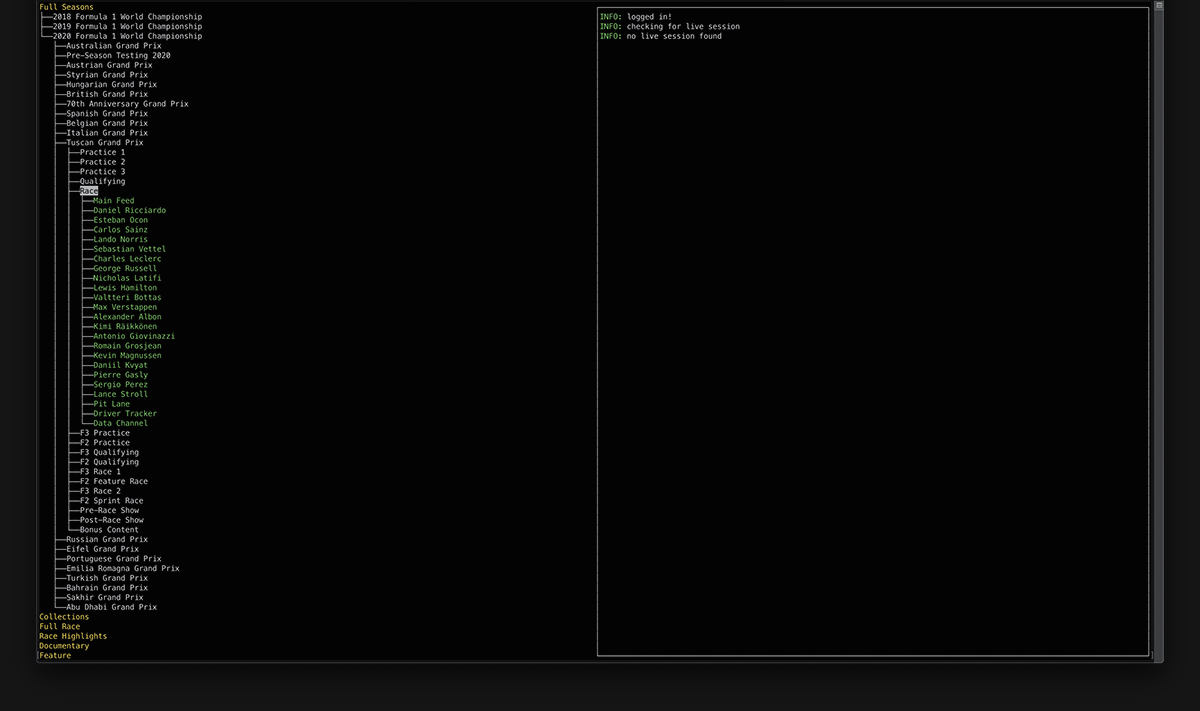 f1viewer
I still do not think I became a sports guy exactly. But apparently I am very much a Formula 1 guy.