I just finished watching Mike Cessario’s MasterClass on building Liquid Death, and the more useful lesson is not “be weird on the internet.”
That leaves out how the business works.
Liquid Death sells water in packaging that buyers can use to express a sense of humor and a preference for the brand.
The reported $1.4 billion valuation is useful mostly as context. It came from private financing coverage in March 2024, not audited public-company reality, and it is not the argument.
The argument is more interesting than the number anyway.
Liquid Death took the most boring object in the beverage aisle and turned it into a social signal. Not because the water was magically different. Because the brand understood something too many companies miss: in categories where the product differences are tiny, packaging and brand associations can give people a reason to choose.
The Product Was a Prop
Water is an absurdly good category for a brand person because the functional claims are almost exhausted. It hydrates you. Great. So does the thing next to it.
Cessario’s insight was not that consumers secretly wanted “better water.” It was that the entire category looked and behaved the same. Clear plastic bottle. Blue label. Mountains. Purity. Wellness. Whispery copy about nature. The emphasis is usually freshness and purity.
Liquid Death used a skull and a tallboy can associated with beer or energy drinks.
That contrast did a lot of work. A can that looked like beer or an energy drink created instant confusion: wait, what is that? Is that allowed? Why is someone drinking that at work? Then the reveal: it is water.
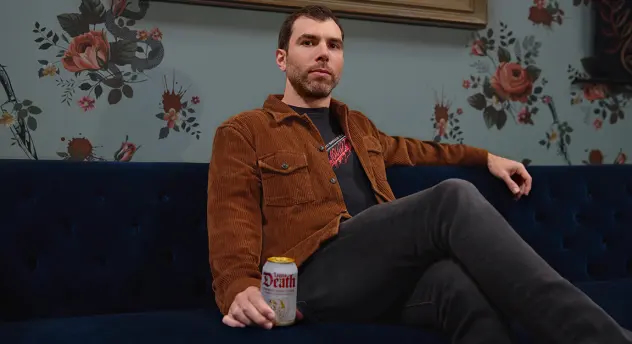
The can lets the buyer participate without explaining anything. You can carry it at a concert, in a meeting, at Target, on a set, wherever, and the packaging makes the joke recognizable without an explanation.
The packaging advertises the brand whenever someone carries the can.
Packaging as Media
Liquid Death’s packaging stands out among conventional water brands.
The name, the skull, the tallboy format, the “Murder Your Thirst” posture: all of it turns the package into a miniature campaign. It is designed to be noticed on a shelf, held in a hand, photographed, misunderstood, explained, and shared.
In the MasterClass episode, Cessario says the first proof-of-demand test was a cheap commercial and small paid-media pushes before the product was broadly available. The exact production numbers are less important than the operating move: test the brand system before the business can fully exist.
Does the name stop people? Do people share the joke? Do people understand the anti-marketing joke? Do they ask where to buy it? Can this thing generate demand before there is distribution?
For operators, that is the useful part. When the object itself is funny, strange, or socially legible, every asset gets easier. The commercial, the shelf, the social post, the merch, the event placement, the celebrity stunt: they are all expressions of the same object.
The Joke Has Rules
The easy mistake is to look at Liquid Death and think the strategy is “say death a lot.”
It is not.
The strategy is tone discipline.
Cessario talks about the brand like a character, closer to professional wrestling than conventional beverage marketing. Everybody knows it is theatrical. That is why it works. The audience is not being deceived; they are being invited.
This is also why the joke can reach people who do not care about metal, punk, skateboarding, or skulls. A mom at Target does not have to be a Slayer fan to understand why a can of water pretending to be dangerous is funny. The joke is not “we are hardcore.” The joke is “water has been given the emotional styling of something you are not supposed to drink at 10:30 in the morning.”
That distinction matters.
The brand is rebellious, but it is not incoherent. Its tone has limits. Cessario mentions using something like an SNL standard as a taste filter: sharp enough to be funny, not so reckless that Walmart pulls it off the shelf. Retail relationships affect which jokes the company can use.
You can be rude. You can be dark. You can be absurd. But if you are building a real brand with real retail partners, the team needs agreed limits for what it will publish.
Merchandise Extends the Brand
The merch is easy to dismiss as brand hype, but I think it is central.
Liquid Death shirts, skateboards, odd collaborations, novelty products, and limited drops make the brand recognizable beyond beverages. They give people more ways to declare affiliation than simply buying a can of water.
The Tony Hawk blood skateboard thing is the cleanest example. On paper, it is ridiculous: get Tony Hawk as an ambassador, put his actual blood in the ink for limited-edition skateboards, film the process, sell the boards, let the internet argue about it.
Public reports put the drop at 100 boards priced at $500 each, with The National reporting they sold out in under 20 minutes. In the MasterClass episode, Cessario also claims the campaign generated huge media attention from a relatively small production spend. That is exactly the kind of PR math you should treat carefully.
But strategically, the lesson holds even if the claimed reach is overstated.
They did not just make content about a product. They made another product that created content.
A funny video can be ignored. An unusual physical product can attract coverage of its own. People share it because the existence of the thing is the story.
The product gives people another reason to talk about the brand.
Distribution Makes Purchase Possible
The shelf is part of the joke.
The can has to show up in places where the performance makes sense: concerts, convenience stores, grocery aisles, coolers, offices, gyms, sets, parties. If it only exists online, the joke is smaller. If it is only a DTC novelty, it becomes a gag gift. Distribution lets people buy the water after seeing the campaign.
The campaigns make people aware of Liquid Death; stores make it available. Retail presence gives you a chance to act on that memory when you are thirsty, bored, curious, or standing in front of a cooler trying to choose between seventeen brands of flavored bubbles.
According to Cessario, Liquid Death had to launch online because retailers resisted putting the name on shelves. Public materials from the company later said the brand had reached 113,000 retail doors across the U.S. and U.K. and $263 million in 2023 retail scanned sales. Again, these are company-reported figures. But the direction is the point. The brand did not stop at attention. It built a path from attention to purchase.
That is where a lot of “wild brand story” analysis falls apart. Attention is not a business model by itself. Attention plus a distinctive object plus repeatable distribution starts to become one.
What Other Teams Can Apply
Apply the underlying decisions to the category you work in.
Category Contrast
Do not start by asking how to be a slightly better version of everyone else. Ask what the category has made illegal, embarrassing, absent, or unthinkable. Liquid Death used aggressive comic imagery in a category dominated by purity and nature.
Packaging as Media
The package is not just a container. It can attract attention in a store, a photograph, or a customer’s hand. If the package needs a campaign to explain why it is interesting, the campaign is doing too much work.
Tone Discipline
A wild tone still needs rules. Especially a wild tone. Taste is operational. It affects scripts, edits, partners, retail relationships, approvals, and which ideas get killed even when everyone in the room laughs.
Merchandise
The question is not “what swag can we sell?” It is “what other products would customers enjoy from this brand?” A shirt, skateboard, novelty product, or absurd collaboration can prove the brand has a culture around it, not just a SKU list.
Choosing Where to Sell
Put the object where the joke gets better. Liquid Death makes obvious sense at a concert. It is also funny in a boardroom because it looks wrong there. Where people encounter the product affects how they interpret it.
The Useful Distinction
Liquid Death questioned familiar conventions in water marketing: natural imagery, restrained packaging, and an earnest emphasis on health. It replaced them with a recognizable comic tone and maintained that tone across packaging, campaigns, and merchandise.
Retail distribution then gave interested people a way to buy it. Other teams can learn from how those decisions support one another without copying the skulls or the stunts.